2026-09
Catalogues you can edit Feature
Customer types, zones and supplier families stop being fixed lists: they can be added, renamed, paused and removed — and one still in use cannot be deleted, only paused.
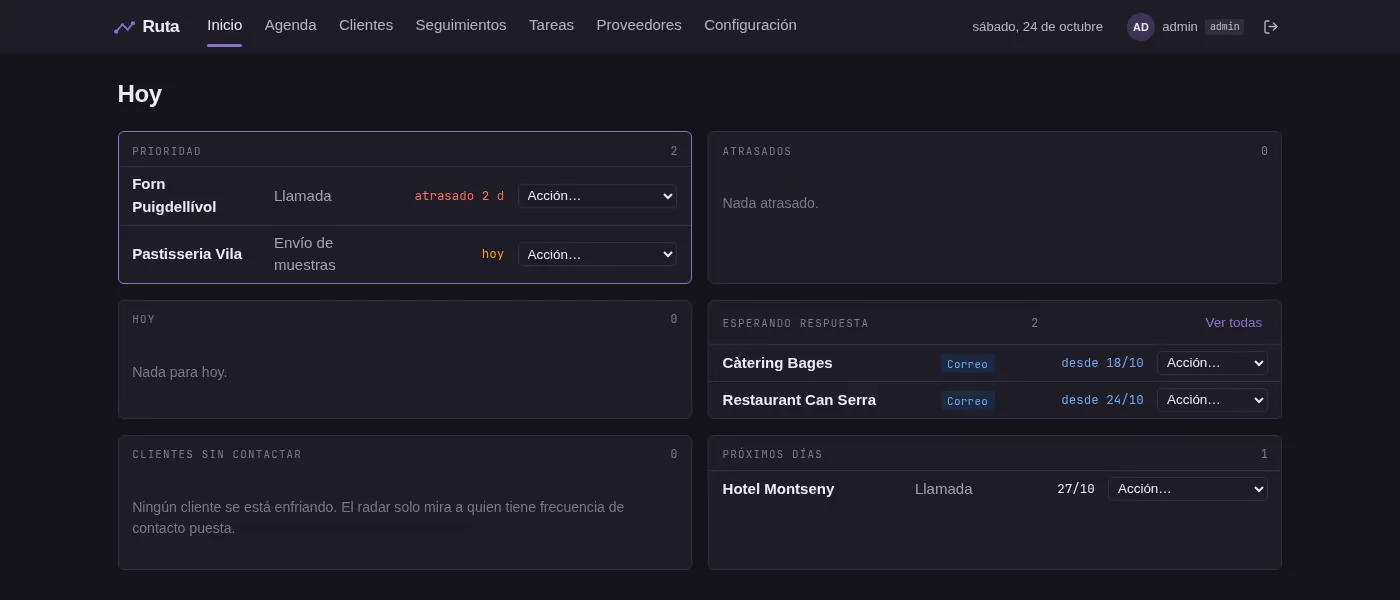
A daily operations board for one person who sells on the road: customers, every contact with them, follow-ups and tasks, and a dashboard that answers in under a minute what needs doing today.
The work lived in a notes app: hundreds of customers, years of visits and calls, and follow-ups that only existed if somebody remembered them. Ruta keeps the same record and adds the part a notes app cannot — it knows what is late.
The dashboard sorts everything into sections — priority, overdue, today, waiting on the customer, customers going cold, the days ahead — and every item lands in exactly one. Colour carries four meanings and no others: late, today, waiting, done. Facts that follow from the record — the last contact, the next follow-up — are computed when read and never stored, so they cannot drift from it.
It started with a specification, not code. Every rule is numbered and the code cites it; when the two disagree, the code is wrong, or the rule changes first, with its reason written down. Then the real record was imported — 261 customers — and it showed three places where the specification was wrong before a line of interface existed.
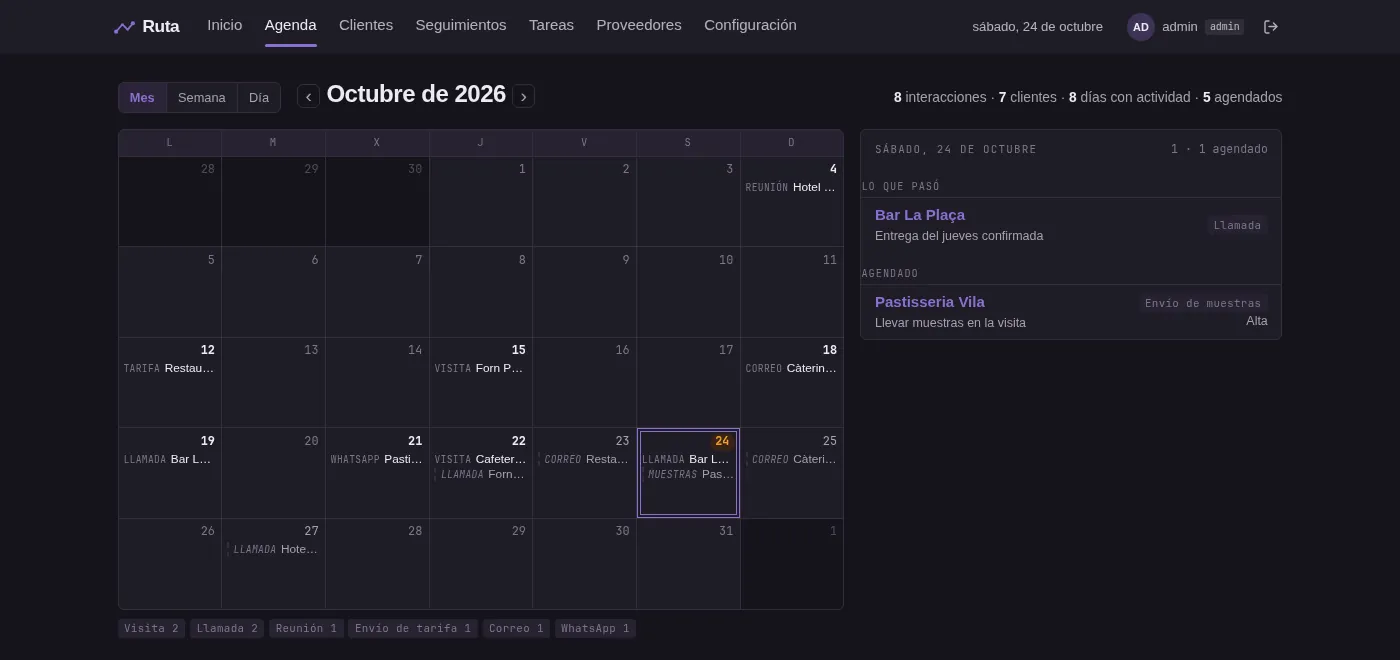
Then the loop that justifies it. Customer record, contact, follow-up, done — editable where it is read, from the row itself. Then tasks, suppliers and an agenda by week and day; a mail logged as sent starts out waiting for the reply.
Then the things that make it trustworthy. Email as the login, a code by mail on every sign-in, recovery by link, and a daily report that goes out on its own. It is not in daily use yet: moving the real record over is the next step.
Customer types, zones and supplier families stop being fixed lists: they can be added, renamed, paused and removed — and one still in use cannot be deleted, only paused.
Email as the credential, password plus a code by mail on every sign-in, recovery by link, and a morning report that sends itself.
The three screens the model was missing, and an agenda by week and day beside the dashboard.
Years of notes imported — 261 customers, their history, tasks and suppliers — and the specification corrected where the data proved it wrong.
Numbered rules, a colour identity where colour means state, and the open questions written down with their dates — before any code.